The Substitution Trap: Why Deleting One App Doesn't Work
You deleted TikTok. Felt great for three days. Now you’re on Reddit two hours a night and somehow it’s worse.
Welcome to the substitution trap. It’s the most common way “I quit social media” quietly turns into “I still scroll for hours,” and almost nobody warns you about it, because the app you deleted was never the actual problem.
The hours don’t disappear. They move.
Here’s what deleting one app really does. It removes one destination. It does nothing to the habit that was driving you there.
The habit is: empty moment → reach for phone → find something to scroll. Delete TikTok and every part of that loop survives except the last word. You still hit the empty moment. You still reach. Your thumb still needs somewhere to land. So it lands on the next-best feed — Reddit, YouTube, Instagram, the news, whatever’s still installed. The hours you “freed up” get instantly absorbed by the next app in line.
This plays out constantly. Someone quits Instagram and lands on Reddit. Someone quits Reddit — see Reddit addiction, because it’s the classic substitute, the “productive” scroll that isn’t — and lands on YouTube. The specific app is a rounding error. The loop is the thing.
One person described a full year of this: “I tried to quit doom scrolling for over a year. Deleted apps. Set screen time limits. Every time, I was back within 48 hours.” Back within 48 hours — but back where? Not always the same app. That’s the trap. You keep winning the small battle (this app is gone) and losing the war (I’m still scrolling).
Why it feels like progress when it isn’t
Deleting an app gives you a genuine hit of relief, and that relief lies to you.
For a few days the substitute isn’t as sharp. Your Reddit feed hasn’t learned you as well as TikTok had. The dopamine is a little weaker, so you feel like you’re recovering. You tell people you quit. You believe it.
Then the algorithm catches up. The substitute learns what stops your thumb, tunes itself, and within a week or two it’s just as sticky as the thing you deleted. You’ve traded a habit you understood for one you’re still building — and you’ve used up the “I quit” story on an app that was never the point. The scale of the loss only lands later: “I was basically sleeping, scrolling, and living a ghost life.” The app changed three times. The ghost life didn’t.
The real thing you’re addicted to
You’re not addicted to TikTok. You’re addicted to scrolling — to the variable-reward loop that any feed provides. TikTok, Reels, Shorts, Reddit, X, the news, even a shopping app in a pinch. They’re interchangeable delivery systems for the same drug.
This is why the whack-a-mole never ends. Delete one, another pops up, because you’re treating the delivery system when the problem is your relationship to the loop itself. It’s also why the deeper you go, the more apps you’ll find yourself “quitting,” each one a symptom you mistake for the disease.
If it were really about one app, deleting it would fix you. It doesn’t. So it isn’t.
Why blockers and limits fall into the same trap
Screen time limits and app blockers are just faster substitution. You block Instagram, and forty-five seconds later your thumb has opened something else — no deletion required. The block only redirects the loop. And the block itself doesn’t hold, because breaking it costs nothing. One person’s honest verdict on years of trying: “Every app blocker I’ve used I eventually turned off and felt worse for it.”
Off with one tap. Felt worse. That’s the pattern for every willpower-based tool — it fights the destination and ignores the driver. More on why that whole category fails: how to break phone addiction without blocking apps and screen time limits don’t work.
What actually breaks the loop
You can’t win the substitution game one app at a time. There are always more apps. You have to change the thing all the substitutes share: the reward of scrolling itself.
Two directions actually address the loop instead of the destination:
- Replace the moment, not the app. The trap starts at the empty moment, so give that moment somewhere real to go. A book in your pocket, a walk, a task with a five-minute first step. See what to do instead of scrolling for the practical list. This won’t fully hold on its own — the phone is faster — but it changes what your thumb reaches for.
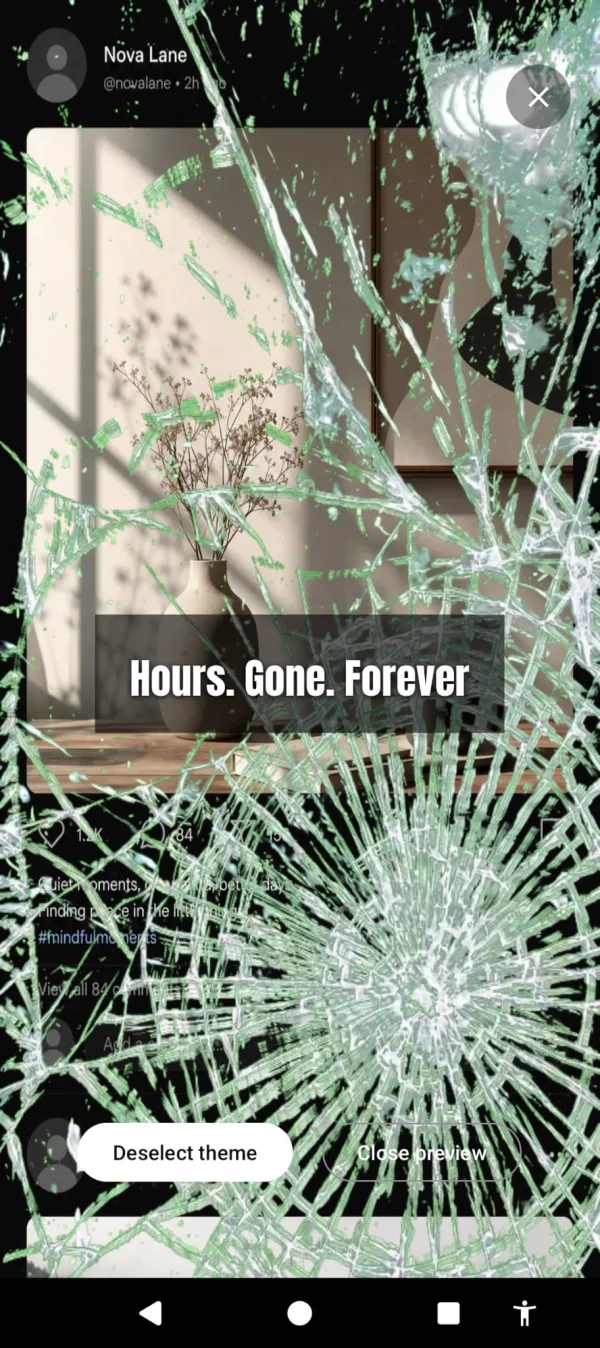
- Break the trance, in every feed you use. This is where Arise comes in. It doesn’t block any single app (on Android, unless you ask it to), so there’s nothing to substitute around. Your phone is designed to hook you, and every feed runs the same trance. Arise breaks it with visual reminders. Put every feed on your list of life-stealing apps and websites — TikTok, Reddit, YouTube, the news sites — and after a grace period a reminder appears over whichever one you’re in, growing stronger the longer you stay: hellfire creeping in from the edges, glass cracking across the feed. Time across everything on your list adds up together, so switching apps doesn’t reset anything. Delete TikTok and open Reddit instead? The reminder follows you there too, because it was never about which app.
That’s the whole point. A blocker plays whack-a-mole with destinations. Arise goes after the trance they all run on. On Android, nothing is blocked unless you ask it to. You can keep scrolling — on any app you want. You just won’t want to.
Open a different app on your list and the cracks follow you. It was never about which app.
You don’t have to go dark, either. Pick a beautiful theme instead — aurora and golden light wash in, or butterflies and wildflowers slowly fill the screen, to remind you of the world waiting off it. Dark themes or beautiful ones, your call. And a streak tracks the days you stay under your limit, so the hours you claw back finally show up somewhere.
Stop counting apps
The scoreboard isn’t “how many apps have I deleted.” It’s “how many hours am I still scrolling.” Those are different numbers, and the substitution trap is the gap between them.
Quitting one app and feeling addicted anyway isn’t failure. It’s information: the app was never the disease. Once you stop treating the destination and start treating the loop, the whole exhausting game of delete-and-replace can finally end.
Your phone is stealing your life — all of it, not just the app you deleted. Now you can see it.
Take back your life from your phone
Your phone is built to keep you scrolling. Arise breaks the trance with visual reminders that grow the longer you stay, and it can lock an app when you want a hard stop.
Get Arise on Google Play