Dumb Phone Alternative: Keep Your Smartphone
The dumb phone pitch is appealing. Buy a $100 flip phone. No apps. No scroll. No addiction. Problem solved.
Then you need to navigate somewhere. No Google Maps. You need to deposit a check. No banking app. Your kid’s school sends a message on an app. You need two-factor authentication for work. You need to show a boarding pass. You need to take a photo.
So you carry two phones. The dumb phone for calls and texts. The smartphone in your bag “for emergencies.” Within a week, the smartphone is back in your pocket and the dumb phone is in a drawer.
The Light Phone II ($299; the newer Light Phone III runs $799) and Punkt MP02 (~$299) tried to solve this with premium dumb phones that include a few essentials — maps, music, a basic browser. They’re beautiful objects. They still can’t run your banking app, your work Slack, your kid’s school portal, or your boarding pass.
Why people want dumb phones
Nobody wants a worse phone. They want less compulsive phone use. The dumb phone is a proxy for the real desire: “I want to stop scrolling without having to fight my phone every day.”
That desire is valid. The solution — downgrade your hardware — is wrong. The hardware isn’t the problem. The software running on it is. Specifically, the 5-6 apps designed by teams of engineers to maximize the time you spend in them.
You don’t need a dumber phone. You need something that breaks the trance when the scroll runs long.
What dumb phone users actually miss
People who’ve tried dumb phones report the same pattern. Week 1: freedom, relief, novelty. Week 2: inconvenience starts accumulating. Week 3-4: the smartphone is back.
What kills it:
- Maps. Real-time navigation isn’t optional in 2026. Light Phone’s directions feature is a stripped-down version that can’t match Google Maps.
- Banking and payments. Mobile deposits, Apple Pay, banking apps. Can’t do any of it on a flip phone.
- Two-factor authentication. Half your accounts use SMS or authenticator apps for 2FA.
- Photos. A 2MP flip phone camera in a world where your phone is also your only camera.
- Work tools. Slack, Teams, email, calendar. Most jobs require a smartphone.
- Emergency information. Medical ID, emergency contacts, health insurance cards stored digitally.
The dumb phone forces you to choose between reducing your phone addiction and functioning in a world built for smartphones. That’s a false choice.
The middle ground that works
minimalist phone (free, ~4.5 rating, 5M+ downloads) replaces your home screen with a text-only launcher. No app icons, no widgets, no visual triggers. You can still access every app — you just type its name instead of tapping an icon. The visual simplification reduces autopilot opens while keeping full smartphone functionality.
Grayscale mode removes color from your screen. Apps look boring. Thumbnails lose their pull. It works for about two weeks before your brain adapts. See our full take on grayscale phones.
Notification pruning. Turn off every notification except calls, texts, and calendar. Most phone pickups start with a notification. Remove the trigger and the pickups drop. This takes 5 minutes and costs nothing.
These are all friction-based approaches. They make the phone less inviting. They work until your brain adapts to the new baseline. Grayscale becomes normal. The minimalist launcher becomes familiar. The reduced notifications stop feeling unusual.
A smartphone that breaks the trance when the scroll runs long
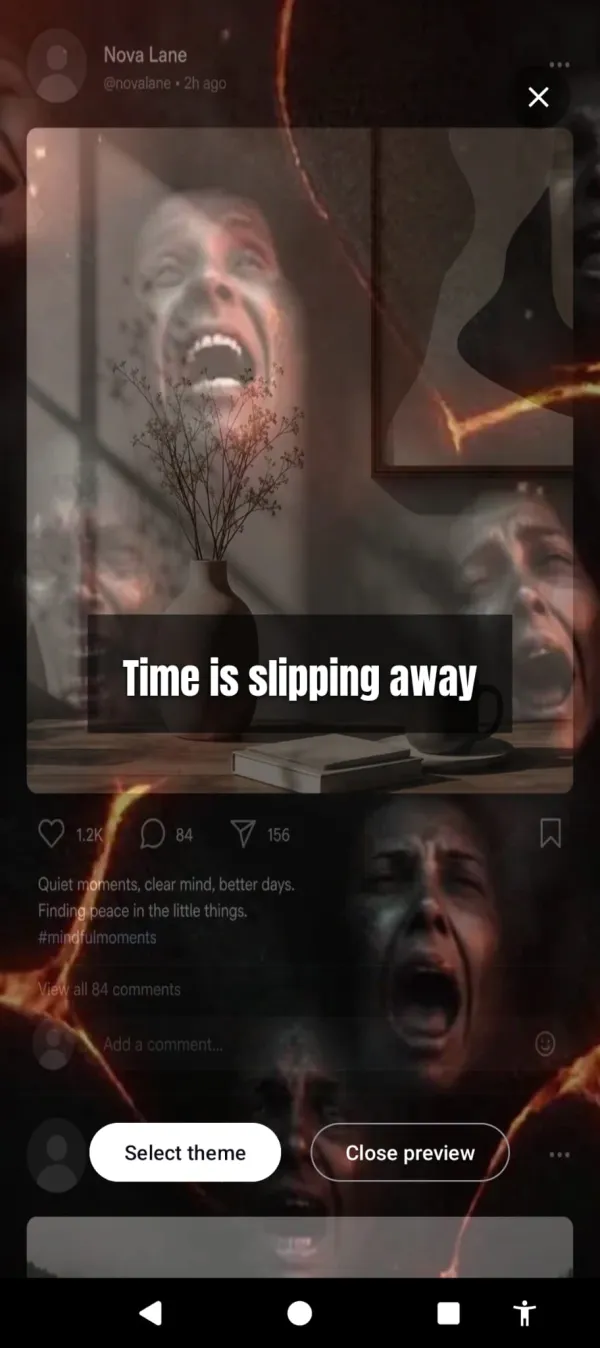
Arise takes a different approach. Instead of making the phone permanently less appealing (which your brain adapts to), it steps in only when and where the trance takes hold. Your phone is designed to hook you, and those 5-6 apps are where it happens. You pick them as your life-stealing apps and websites. After a grace period, a visual reminder appears over them and grows stronger the longer you stay.
Keep the smartphone. Your feeds just catch fire when the scroll runs long.
Maps, texts, banking, photos — anything off your list never gets a reminder, no matter how long you use it. Your life-stealing apps look normal too, until the grace period runs out. After that, the reminder creeps in from the edges. Hellfire. Glass cracking. Insects crawling. Newer themes fill more of the screen as the minutes pass: frost spreading over the glass, autumn leaves piling up. The longer you stay, the stronger it grows.
Put the phone down and the reminder fades, and with session tracking your grace period refills while the phone is down. The phone distinguishes between “quick functional use” (clean) and “40-minute scroll” (a reminder you can’t miss). A dumb phone can’t make that distinction. It treats everything equally.
You keep your smartphone. You keep every app. Maps, banking, camera, work tools — all functional, all untouched. The only thing that changes is the experience of extended scrolling. And that change makes you want to stop.
| Dumb Phone | minimalist phone | Arise | |
|---|---|---|---|
| Maps | No/limited | Yes | Yes |
| Banking/payments | No | Yes | Yes |
| Camera quality | Bad | Full | Full |
| Work apps | No | Yes | Yes |
| Reduces scrolling | Yes (nothing to scroll) | Somewhat (less visual) | Yes (reminder grows with use) |
| Adapts over time | N/A | Brain adapts in ~2 weeks | Changes dynamically |
| Price | $100-$400 | Free | Free; premium monthly, yearly or lifetime |
Arise is free to use on Android and iPhone (on iPhone it blocks apps; the visual reminders are Android only). Premium themes, focus mode and Child Lock come with a monthly, yearly or lifetime plan. Keep your smartphone. Keep your apps. Lose the endless scroll. The phone handles the rest.
Take back your life from your phone
Your phone is built to keep you scrolling. Arise breaks the trance with visual reminders that grow the longer you stay, and it can lock an app when you want a hard stop.
Get Arise on Google Play